

Most people discover batana oil through a before-and-after photo or a glowing review from someone whose hair went from brittle and dull to thick and shining. They order a bottle, fall in love with it, and then if they’re anything like us — start wondering: where does this actually come from?
The answer leads you to a plant called Elaeis oleifera.
You won’t find it at a garden center. You won’t see it growing in tidy rows on a commercial farm. This is a wild tropical palm tree that grows deep inside the rainforests of Central and South America — most famously in the remote region of La Mosquitia, Honduras. And it has been quietly producing one of nature’s most nutrient-dense oils for centuries.
In this article, we’re going to introduce you to Elaeis oleifera properly — what it is, where it grows, how it differs from other palm trees, what’s actually inside its oil, and why it’s the only plant that produces genuine batana oil.
Elaeis Oleifera — Let’s Start With the Name
Science loves Latin names, and this one is worth understanding because it tells you something important about the plant.
Elaeis comes from the Greek word elaion, meaning oil. Oleifera comes from Latin — oleum (oil) + ferre (to bear or carry). Put it together and you get: oil-bearing oil plant. Scientists weren’t being poetic when they named this one. They were being accurate.
The plant belongs to the Arecaceae family — the palm family — and sits in the same genus as its more famous (and more commercially exploited) cousin, the African oil palm (Elaeis guineensis). But don’t let that shared genus fool you. These two plants are genuinely different in meaningful ways, and we’ll get into exactly why that matters in a moment.
Elaeis oleifera goes by several common names depending on where you are:
- American oil palm
- American palm tree
- Corozo palm (in parts of Colombia and Panama)
- Batana palm (among the Miskito people of Honduras)
It’s the same plant. Just known by different names across the communities that have lived alongside it for generations.
Where Does Elaeis Oleifera Grow?
This palm doesn’t grow just anywhere. It’s particular about its environment — and honestly, that pickiness is part of what makes it special.
Elaeis oleifera is native to Central and South America, with its natural range stretching from Honduras and Nicaragua in the north, down through Costa Rica, Panama, Colombia, Brazil, and into parts of Peru and Ecuador. It thrives in lowland tropical rainforests where rainfall is heavy, humidity is high, and the soil is rich and well-drained near river systems.
In Honduras specifically, the tree grows wild throughout La Mosquitia — the vast, largely roadless rainforest that covers the northeastern corner of the country. This is one of the most biodiverse regions in the Western Hemisphere, and the American palm tree flourishes there without any human cultivation or intervention.
That last point is important. Unlike African oil palm plantations — which are responsible for massive deforestation across Southeast Asia and parts of Africa — Elaeis oleifera in La Mosquitia grows entirely in the wild. Nobody planted it. Nobody clears land to grow it. The Miskito people simply harvest what the forest already provides.
It’s genuinely hard to think of many commercial beauty ingredients that work this way. Most have been industrialized beyond recognition. This one hasn’t.
What Does the Elaeis Oleifera Tree Look Like?
If you were standing in La Mosquitia and someone pointed one out to you, here’s what you’d see.
The American palm tree is a medium-sized palm, typically reaching between 3 and 9 meters in height (roughly 10 to 30 feet). Unlike the towering coconut palms most people picture, Elaeis oleifera tends to grow with a slight lean or curve — its trunk angling outward rather than shooting straight up. Old trees sometimes grow nearly horizontally along the ground before curving upward, which gives mature stands of them a distinctive, almost sprawling character.
The leaves are long and feathery — classic palm fronds that can stretch 2 to 3 meters in length. They grow in a dense crown at the top of the trunk, and the base of each frond is lined with sharp spines. Getting close to harvest the fruit clusters isn’t exactly a casual activity.
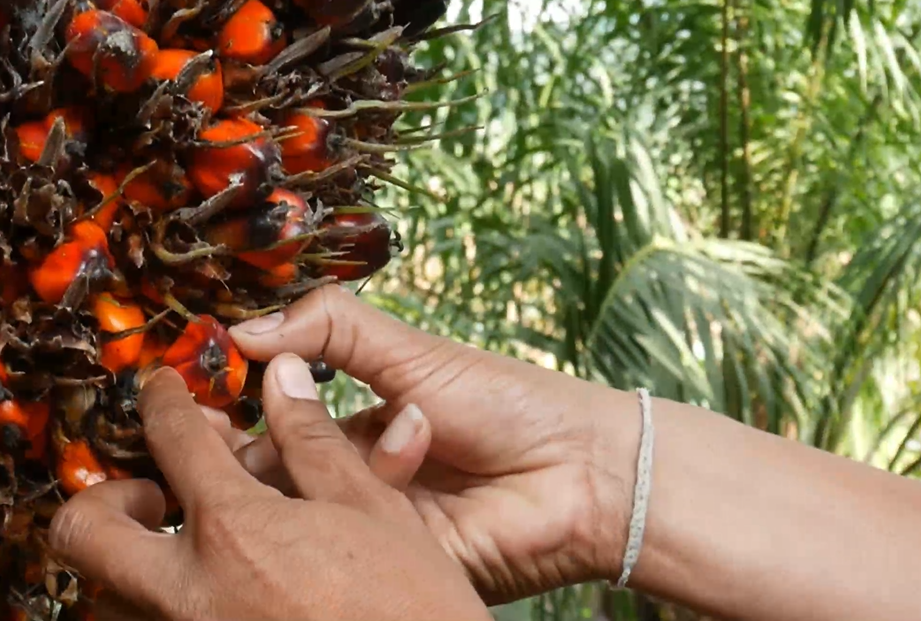
The fruit is where everything interesting happens. Elaeis oleifera produces dense clusters of small, oval drupes — each fruit roughly the size of a large olive. When ripe, the outer skin shifts from green to a deep reddish-orange. The clusters themselves can be quite heavy, sometimes weighing several kilograms each.
Inside each fruit is a fibrous outer pulp (the mesocarp) surrounding a hard shell, and inside that shell sits the kernel — the small, oil-rich seed that the Miskito people press to make batana oil.
Everything about the tree’s appearance signals abundance. It’s not showy. It’s not dramatic. It just quietly produces, year after year, in the middle of one of the most alive ecosystems on the planet.
Elaeis Oleifera vs. Elaeis Guineensis — Why the Difference Matters
This is the comparison that matters most if you care about what you’re putting on your hair — and on our planet.
Elaeis guineensis is the African oil palm. It’s the source of the palm oil that shows up in approximately 50% of packaged consumer products worldwide — from margarine and instant noodles to lipstick and shampoo. It’s one of the most productive oil crops on earth, and its cultivation has driven catastrophic deforestation in Indonesia, Malaysia, and parts of West Africa.
Elaeis oleifera is a completely different story — in almost every way.
Here’s a straightforward comparison:
| Feature | Elaeis oleifera (American Palm) | Elaeis guineensis (African Palm) |
|---|---|---|
| Origin | Central & South America | West & Central Africa |
| Growth | Wild, uncultivated | Commercially farmed |
| Oil yield | Lower, more selective | Very high volume |
| Oil color | Dark reddish-brown to amber | Bright orange-red (crude) |
| Oleic acid content | Higher | Lower |
| Vitamin E (tocopherols) | Higher concentration | Lower concentration |
| Environmental impact | Minimal (wild harvested) | Significant deforestation risk |
| Traditional use | 500+ years by Miskito people | Commercial/industrial |
The African oil palm produces more oil per tree. That’s why the commercial industry chose it. But Elaeis oleifera produces better oil — with a different fatty acid profile, higher antioxidant content, and a composition that’s genuinely more compatible with human skin and hair.
Researchers have actually been studying Elaeis oleifera as a potential breeding resource to improve African oil palm varieties — specifically because of its higher oleic acid content and better nutritional profile.
(USDA research on Elaeis oleifera — NCBI/PubMed)
In other words, scientists trying to make African palm oil better keep looking to the American palm for answers. That tells you something.
What’s Actually Inside Elaeis Oleifera Oil?
Here’s where things get genuinely exciting — because the chemistry of this oil is what explains why the Miskito people have trusted it for centuries.
When you cold-press the kernels of Elaeis oleifera, the resulting oil contains a remarkable lineup of compounds:
Fatty Acids
- Oleic Acid (Omega-9): The dominant fatty acid in batana oil. Oleic acid penetrates the hair shaft deeply, moisturizing from within rather than just coating the surface. It’s the same fatty acid that makes olive oil and argan oil so beloved for skin and hair care.
- Linoleic Acid (Omega-6): Supports scalp health, helps regulate sebum production, and strengthens the hair’s outer cuticle layer.
- Palmitic and Stearic Acids: Provide a protective layer on the hair shaft, reducing moisture loss and environmental damage.
Antioxidants
- Tocopherols (Vitamin E): Elaeis oleifera is notably high in tocopherols — particularly alpha and gamma tocopherol. These are powerful antioxidants that protect hair follicles from oxidative stress, support scalp circulation, and are directly linked to healthy hair growth cycles.
- Carotenoids: The reddish color of raw batana oil comes partly from natural carotenoids — precursors to Vitamin A that support cell regeneration and scalp health.
Phytosterols
These plant-based compounds help strengthen the hair’s lipid barrier, reduce inflammation on the scalp, and support the overall health of the follicle environment.
What’s NOT in it
Authentic, raw Elaeis oleifera oil contains no synthetic fragrances, no preservatives, no additives, and no petroleum derivatives. What you get is exactly what the tree produces — nothing added, nothing removed.
This is why the cold-press extraction method matters so much. Heat and chemical processing destroy tocopherols and degrade fatty acids. Raw, traditionally pressed batana oil keeps all of these compounds intact and active. (See our [how batana oil is made] post for a deeper look at the extraction process.)
Why Elaeis Oleifera Is Rare — And Why That’s Actually a Good Thing
Elaeis oleifera has never been commercially farmed at scale. And honestly? That has protected it.
Because it grows slowly, produces fruit in smaller quantities than African oil palm, and thrives only in specific wild rainforest environments, it never made economic sense for large agricultural operations to industrialize it. So they didn’t. And as a result, the American palm tree in Honduras exists today much as it always has — wild, unhurried, and chemically untouched.
The Miskito people harvest it by hand, in small batches, according to seasonal rhythms they’ve observed for generations. There’s no mass production. There’s no factory somewhere churning out drums of the stuff.
This scarcity is real. It’s one of the reasons authentic batana oil costs more than the cheaply diluted versions flooding certain marketplaces. If you see a large bottle of “batana oil” selling for a few dollars, that should raise an immediate question about what’s actually in it.
Real Elaeis oleifera oil takes time, skill, and physical labor to produce. It comes in limited quantities. And it comes from one of the most remote places in Central America.
That’s not a marketing angle. That’s just the reality of how this plant works. Check out the SHOP to see exactly what genuine sourcing looks like.
Elaeis Oleifera and Science — What Research Actually Says
Traditional knowledge and modern science don’t always agree. In the case of Elaeis oleifera, they line up remarkably well.
Several peer-reviewed studies have examined the composition of Elaeis oleifera oil and confirmed what the Miskito people have known through practice for centuries:
- The oil’s high tocopherol content makes it a potent antioxidant for protecting hair follicles and skin cells from free radical damage.
- Its oleic acid dominance gives it superior penetration ability compared to oils with higher saturated fat content — meaning it actually gets into the hair structure rather than sitting on top of it.
- Research comparing Elaeis oleifera and Elaeis guineensis consistently shows that the American species has a more favorable unsaturated fatty acid profile — which translates directly to better moisturizing performance for hair and skin.
- Some studies have flagged Elaeis oleifera as having anti-inflammatory properties relevant to scalp conditions like seborrheic dermatitis and dry, irritated scalps.
(Comparative analysis of Elaeis oleifera and Elaeis guineensis — Research Gate or PubMed)
The science isn’t surprising when you understand what’s in the oil. What is surprising is how long it took the broader beauty industry to pay attention to a plant that indigenous communities had figured out half a millennium ago.
From Wild Palm Tree to Your Hair — The Connection
Understanding Elaeis oleifera changes the way you think about batana oil.
It’s not a trendy extract manufactured in a lab. It’s not an isolated compound synthesized to mimic something natural. It is the direct, minimally processed product of a wild tropical palm tree that grows in one of the most pristine rainforest environments on earth — harvested by people who have a relationship with it that spans hundreds of years.
When you understand the plant, you understand why the origin matters. You understand why “batana oil” made from different species or processed with industrial methods simply isn’t the same thing. And you understand why the communities who have cultivated this knowledge deserve to be at the center of any conversation about this ingredient.
At rawbatanaoil.com, we source our oil directly from Miskito producers in La Mosquitia — people who know Elaeis oleifera not from a research paper but from a lifetime of working with it. Every bottle we sell starts with that tree, those hands, and that tradition.
Wrapping Up — A Plant Worth Knowing
Elaeis oleifera is one of those rare things that lives up to its reputation — not because of marketing, but because of biology, tradition, and geography all working together in the same direction.
It grows wild in some of the most untouched rainforest on the planet. It produces an oil with a nutritional profile that scientists keep returning to study. It has sustained a hair care tradition among the Miskito people that has outlasted empires. And it does all of this without requiring a single acre of cleared land or a single drop of industrial chemical.
The next time you hold a bottle of raw batana oil, you’re holding the product of that whole story. A wild palm tree in a Honduran rainforest, fruit harvested by hand, oil pressed through generations of knowledge.
That’s Elaeis oleifera. And now you know exactly what makes it extraordinary.
Key Takeaways
- Elaeis oleifera is the American oil palm — the wild tropical tree native to Central and South America that produces authentic batana oil. It is not the same as the African oil palm (Elaeis guineensis) used in commercial palm oil production.
- The tree grows wild in La Mosquitia, Honduras, thriving without cultivation in one of Central America’s most biodiverse and remote rainforests — meaning it’s harvested sustainably with minimal environmental impact.
- The oil pressed from its kernels is rich in oleic acid, tocopherols (Vitamin E), linoleic acid, and phytosterols — compounds that penetrate the hair shaft deeply, protect follicles from oxidative stress, and support scalp health.
- Elaeis oleifera produces less oil than African oil palm but significantly better oil — with a higher unsaturated fatty acid content and superior antioxidant profile that scientific research continues to confirm.
- Authentic batana oil can only come from Elaeis oleifera, cold-pressed without heat or chemicals. Products made from other species or refined through industrial processes are not genuine batana oil, regardless of what the label says.
Frequently Asked Questions
Q1: What is Elaeis oleifera and how is it different from regular palm oil?
Elaeis oleifera is the American oil palm — a wild tropical tree native to Central and South America. While it belongs to the same genus as the African oil palm (Elaeis guineensis), they are distinct species with very different properties. American palm oil (batana oil) has a higher oleic acid content, more tocopherols (Vitamin E), and a richer antioxidant profile. It’s also wild-harvested rather than commercially farmed, which makes it significantly more sustainable than conventional palm oil.
Q2: Is Elaeis oleifera oil the same as batana oil?
Yes — batana oil is simply the traditional name used by the Miskito people of Honduras for the oil cold-pressed from the kernels of Elaeis oleifera. The two terms refer to the same oil. “Batana” is the name rooted in indigenous tradition and culture; Elaeis oleifera is the botanical classification used by scientists.
Q3: Why is Elaeis oleifera oil so expensive compared to other hair oils?
Several factors drive the cost of authentic Elaeis oleifera oil. The tree grows only in specific wild rainforest environments and is never commercially farmed at scale. The fruit is harvested by hand in small batches. The oil is cold-pressed using traditional methods that preserve its nutritional profile but limit how much can be produced at once. And genuine sourcing requires fair compensation for the Miskito communities who do this work. Cheap “batana oil” products almost certainly contain diluted or substituted ingredients.
Q4: Has Elaeis oleifera oil been studied scientifically?
Yes. Multiple peer-reviewed studies have examined Elaeis oleifera oil’s composition and compared it to African palm oil. Research consistently confirms its higher unsaturated fatty acid content, superior tocopherol concentration, and promising anti-inflammatory properties. Scientists studying ways to improve commercial palm oil crops have repeatedly looked to Elaeis oleifera as a reference for better nutritional and fatty acid profiles — which is a strong indicator of how the two species compare in quality.
