- Free Shipping on All Orders -100% Authentic Batana Oil from Honduras

There’s something quietly powerful about a beauty ritual that has survived five centuries.
No rebranding. No trend cycles. No influencer campaigns driving its popularity. Just generations of women passing down knowledge — mother to daughter, grandmother to granddaughter — about an oil that grew wild in the forest around them and did something remarkable for their hair.
That’s the story of batana oil. And it’s a story worth knowing before you ever open a bottle.
In a world where “ancient remedy” gets stamped on products invented three years ago, the history of batana oil is genuinely, verifiably old. It stretches back at least five centuries among the Miskito people of Honduras — an indigenous community whose relationship with this oil is woven into their culture, their identity, and their daily lives in ways that go far beyond haircare.
Understanding where batana oil comes from — not just botanically, but historically and culturally — changes how you relate to it. It shifts from being another trending ingredient to being something with real roots, real people, and a real story behind it.
So let’s go back to the beginning.
Who Are the Miskito People?
The Guardians of Batana Oil’s Origins
To understand the history of batana oil, you first need to know something about the people who discovered it, cultivated its use, and kept that knowledge alive across generations.
The Miskito — sometimes spelled Moskito or Miskitu — are an indigenous people native to the Mosquito Coast, a stretch of Caribbean lowland that runs along the northeastern coast of Honduras and into Nicaragua. This region is characterized by dense tropical rainforest, river systems, coastal lagoons, and extraordinary biodiversity.
The Miskito have lived in this landscape for centuries, developing a deep and intimate knowledge of its plants, trees, and natural resources. Their relationship with their environment wasn’t extractive — it was reciprocal. They understood the forest not as a resource to be harvested to exhaustion, but as a living system to be tended, respected, and sustained.
This worldview shaped everything about how they related to batana oil — from how they harvested the nuts to how they prepared the oil to how they incorporated it into their lives.
The Miskito people today still inhabit this region, still maintain many of their traditional practices, and in many communities, still produce batana oil using methods that would be recognizable to their ancestors from five hundred years ago.
That continuity is remarkable. And it tells you something important about the value they place on this oil — because traditions that truly work tend to survive.
The American Oil Palm: A Tree the Rainforest Grew Itself
Where Batana Oil Begins
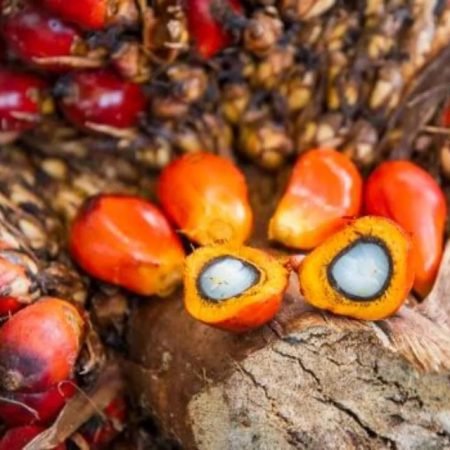
Long before any human decided to plant it, Elaeis oleifera — the American oil palm — was already growing across the lowland rainforests of Central and South America.
Unlike its African cousin Elaeis guineensis, which has been aggressively cultivated into vast industrial plantations, the American oil palm exists largely as a wild tree. It grows at its own pace, in its own time, as part of a complex forest ecosystem rather than a managed monoculture.
The Miskito people didn’t create this tree. They found it, learned from it, and built a relationship with it — one that has sustained both the community and the forest for centuries.
The nuts of the American oil palm grow in dense clusters on the tree’s trunk. They’re small, hard, and packed with a remarkably rich oil that the Miskito recognized as something special long before the outside world had any awareness of it.
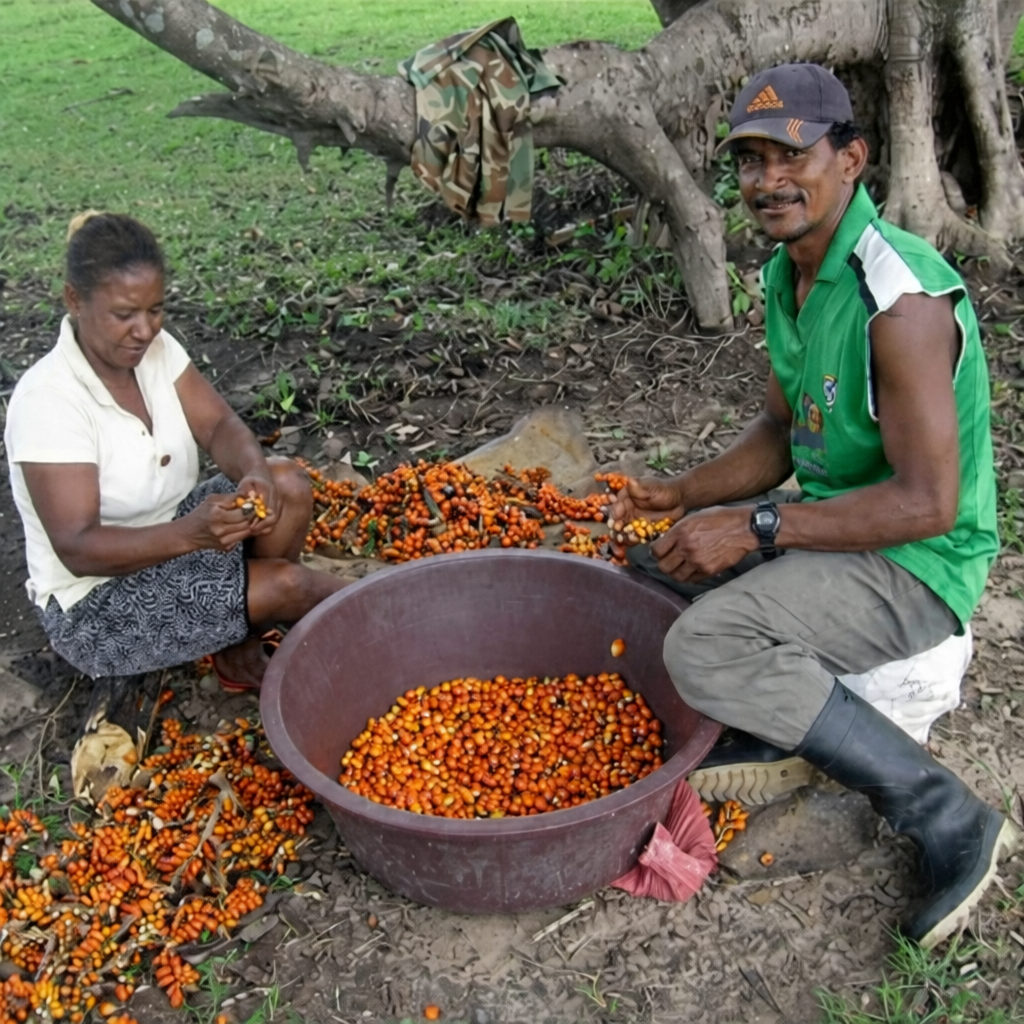
The process of extracting that oil — cracking the nuts, slow-cooking or pressing the kernels, collecting the resulting oil — was refined over generations into a practice that balanced efficiency with preservation of the oil’s natural properties.
What they were doing, without the language of modern nutritional science, was essentially cold-press extraction. They kept temperatures low enough to preserve the oil’s color, scent, and potency. They produced something that modern analysis now confirms is genuinely extraordinary in its nutritional composition.
They didn’t need a laboratory to tell them it worked. Five hundred years of results was evidence enough.
Batana Oil in Miskito Daily Life
More Than a Beauty Product — A Cultural Cornerstone
One of the things that strikes you when you learn about the history of batana oil is how completely integrated it was — and still is — into Miskito life.
This wasn’t something used occasionally or reserved for special occasions. Batana oil was a daily practice, applied to hair and skin as a fundamental act of care and maintenance rather than an indulgence.
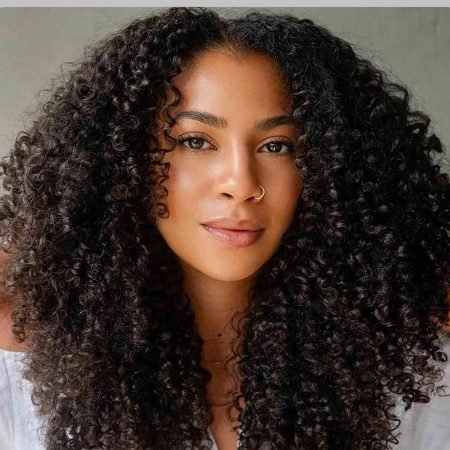
Miskito women are widely observed to have extraordinarily thick, long, deeply lustrous hair — even into older age. Visitors to the Mosquito Coast have noted this for centuries. The Miskito themselves have long attributed it to their consistent use of batana oil, and there’s every reason to believe them.
But the significance of batana oil in Miskito culture went beyond the physical results.
The preparation of batana oil was traditionally a communal activity — women gathering together to process the nuts, extract the oil, and share in both the labor and the conversation that surrounded it. In this way, batana oil production was a social ritual as much as a practical one. It was a context for community, for the passing of knowledge between generations, and for the reinforcement of shared cultural identity.
The oil was also used in ceremonial contexts — applied during rites of passage, celebrations, and moments of cultural significance. Its use marked important transitions and gatherings in ways that elevated it beyond the everyday, even as it remained part of everyday life.
This dual nature — simultaneously ordinary and sacred — is part of what makes batana oil’s cultural history so rich and layered.
The Name Itself: What “Batana” Means
Language as a Window Into History
The word batana comes from the Miskito language, and its etymology offers a small but meaningful glimpse into how the Miskito people related to this oil.
In Miskito tradition, the oil is sometimes referred to in connection with the concept of restoration and beauty — a linguistic framing that reflects the observed effects of the oil on hair and skin over generations of use.
Some accounts also reference the oil being called “ojon” in certain regional dialects — a name that has occasionally been used in the broader natural beauty market. But within Honduras and among the Miskito specifically, batana remains the term most closely tied to the traditional product and its cultural context.
The persistence of the Miskito name in the modern market — rather than a sanitized or anglicized substitute — is itself a small act of cultural acknowledgment. When you say “batana oil,” you’re using the language of the people who discovered it. That matters.
How Knowledge Was Preserved Across Generations
Oral Tradition as Living Archive
Here’s something that often gets lost when we talk about traditional knowledge: it wasn’t written down.
The Miskito people didn’t have a manual for batana oil production. There were no recipes filed in an archive, no formal schools teaching extraction techniques. What they had was something arguably more durable — living knowledge, passed person to person, practiced and refined through direct experience across hundreds of years.
Grandmothers showed granddaughters how to identify the right nuts. Mothers demonstrated the pressure and timing of extraction. Communities developed collective knowledge about storage, application, and the seasonal rhythms of the American oil palm.
This kind of embodied, practiced knowledge is extraordinarily resilient — and extraordinarily at risk of disappearing when the social structures that carry it are disrupted.
The Miskito people have faced significant historical pressures, including colonization, resource extraction by outside interests, and the broader forces of modernization that have touched every indigenous community globally. The fact that batana oil knowledge survived those pressures is a testament to how deeply it was embedded in Miskito cultural identity.
It survived because it worked. And because the women who used it understood its value well enough to make sure it was passed on.
When the Outside World Discovered Batana Oil
From the Rainforest to the Global Market
For most of batana oil’s history, it existed in relative obscurity outside of Honduras and the broader Central American region. The Miskito used it. Some neighboring communities knew of it. But it didn’t travel.
That began to change in the early 21st century, as the global natural beauty movement started looking seriously at traditional plant-based remedies from indigenous cultures around the world. Argan oil from Morocco. Marula oil from sub-Saharan Africa. Moringa from South Asia. Tamanu from the Pacific Islands.
Batana oil found its moment in this broader wave of interest in traditional, minimally processed plant oils — and when it did, the response from the natural haircare community was significant.
People who tried genuine cold-pressed batana oil reported results that were difficult to ignore. Softer, thicker-feeling hair. Reduced breakage. Improved scalp health. A richness and depth to the conditioning that they hadn’t found in other oils.
The internet accelerated this discovery process dramatically. Word spread quickly through haircare communities, natural beauty forums, and social platforms — and suddenly, an oil that the Miskito had known about for five centuries was becoming known worldwide.
This global attention brought both opportunity and risk.
The Double-Edged Sword of Global Popularity
Why Sourcing and Authenticity Matter More Than Ever
When any traditional ingredient becomes globally popular, a predictable pattern tends to follow.
Demand increases rapidly. Supply chains struggle to keep up. Producers who prioritize volume over quality enter the market. Refined, diluted, or outright mislabeled versions begin circulating alongside genuine products. Prices fluctuate. And the communities who originally held the knowledge of this ingredient often find themselves marginalized in the very market their tradition created.
The history of batana oil is now at an inflection point because of this dynamic.
The Miskito communities of Honduras hold the authentic knowledge, the traditional production methods, and the geographic connection to genuine batana oil. Ensuring that the global market for this oil actually benefits those communities — rather than bypassing them in favor of cheaper industrial alternatives — is both an ethical imperative and a practical quality issue.
When batana oil is sourced directly from Miskito producers in Honduras, using traditional cold-press methods, you get the genuine product — with its characteristic deep color, earthy scent, and full nutritional profile intact.
When it isn’t — when it’s industrially produced, refined, or blended with cheaper oils — you get something that shares a name with the traditional product but little else.
This is why the sourcing question isn’t just about ethics, though the ethical dimension is real and important. It’s also directly connected to whether the oil you’re using will actually perform the way genuine batana oil performs.
What Traditional Use Tells Us That Modern Science Is Now Confirming
Ancient Wisdom, Modern Validation
One of the most interesting aspects of the history of batana oil is watching modern nutritional science catch up to what the Miskito already knew empirically.
For centuries, Miskito women observed that batana oil made hair stronger, thicker, shinier, and more resilient. They observed that it seemed to encourage healthy hair growth and reduce breakage. They used it through seasons of stress and change and found that it consistently delivered results.
They didn’t know about oleic acid. They didn’t have terms for tocopherols or beta-carotene or phytosterols. But they were experiencing the effects of all of those compounds, applied consistently over a lifetime.
Modern analysis of cold-pressed batana oil now confirms what traditional use demonstrated through observation:
- High oleic acid content penetrates the hair shaft for deep, lasting moisture
- Beta-carotene supports scalp health and delivers antioxidant protection
- Tocopherols protect hair follicles and support healthy hair growth conditions
- Phytosterols strengthen hair structure and reduce breakage over time
- Natural antioxidants protect against environmental damage and oxidative stress
The Miskito didn’t need peer-reviewed studies to validate what five hundred years of consistent results had already told them. But it’s meaningful that modern science, looking at the same oil with modern tools, arrives at the same conclusion: this is a genuinely remarkable oil for hair and scalp health.
Traditional knowledge and modern science don’t always align this neatly. When they do, it’s worth paying attention.
Batana Oil Today: Honoring the History While Sharing the Benefits
A Living Tradition in a Global Market
The story of batana oil isn’t finished — it’s still being written.
The Miskito people of Honduras are still harvesting American oil palm nuts from wild rainforest trees. Women in these communities are still using batana oil as a daily hair care practice, still passing the knowledge down through families, still maintaining the traditional methods that produce the genuine article.
At the same time, that genuine article is now reaching people around the world who are looking for exactly what it offers — a pure, traditional, nutrient-dense oil that works without synthetic additives, chemical processing, or industrial shortcuts.
The bridge between those two realities — the Miskito tradition and the global natural beauty community — works best when it’s built on transparency, fair sourcing, and genuine respect for the origins of this oil.
At Raw Batana Oil, the commitment to that bridge is foundational. Every bottle of batana oil is sourced directly from Honduras, cold-pressed using methods that honor the traditional process, and sold with full transparency about what it is and where it comes from.
Because the history of batana oil isn’t just a marketing story. It’s a real history, belonging to real people, rooted in a real place — and every bottle of genuine batana oil is a small continuation of that story.
Frequently Asked Questions
Q: How long have the Miskito people been using batana oil?
The documented and oral history of batana oil use among the Miskito people of Honduras spans at least 500 years, though the actual practice almost certainly predates written or recorded accounts. It has been a continuous part of Miskito culture and daily life throughout that entire period — not a rediscovered or reconstructed tradition, but an unbroken one.
Q: Why is batana oil specifically associated with Honduras?
The American oil palm (Elaeis oleifera) grows across Central and South America, but the specific tradition of extracting and using batana oil as a hair treatment is most deeply rooted in the Miskito communities of Honduras’s Mosquito Coast. This region’s combination of the right ecosystem, the right indigenous knowledge, and the right traditional practices produced the specific product that the world now knows as batana oil.
Q: Does buying batana oil support the Miskito community?
It can — but only if you buy from brands that source directly from Miskito producers in Honduras. Purchasing refined or industrially produced alternatives labeled as batana oil typically does not benefit the communities whose traditional knowledge created this product. Choosing brands committed to transparent, direct sourcing is the most effective way to ensure your purchase supports the right people.
Q: Has batana oil always been used specifically for hair?
Primarily, yes — hair and scalp treatment is the most historically documented use of batana oil within Miskito culture. However, the oil has also been used for skin moisturization and in some ceremonial contexts. Its reputation as a hair treatment is the core of its traditional use and the basis of its modern popularity.