- Free Shipping on All Orders -100% Authentic Batana Oil from Honduras

If you’ve been researching batana oil and stumbled across the fact that it comes from a type of palm tree, you might have paused and thought — wait, is this just palm oil with a fancier name?
It’s a fair question. And you’re definitely not the first person to ask it.
Both oils do come from palm species. Both are rich in fatty acids. And at a glance, if you’re not familiar with either one, the botanical overlap can make them seem interchangeable. But spend a little more time looking at the details — the species, the sourcing, the processing, the nutritional profile, the cultural history — and the picture becomes very clear, very quickly.
Batana oil and palm oil are genuinely different products. Not just in the way that marketing teams make things sound different to justify a higher price tag — but different in origin, in composition, in how they’re made, and in what they actually do for your hair.
This post is going to walk you through the real batana oil vs palm oil comparison so you can understand exactly what makes each one what it is — and why those differences matter when you’re choosing what to put on your hair and scalp.
Start With the Basics: Where Each Oil Comes From
Two Different Trees, Two Different Worlds
This is where the batana oil vs palm oil conversation has to begin — at the source.
Palm oil — the kind you find in supermarket products, processed foods, and mass-market cosmetics — comes primarily from Elaeis guineensis, the African oil palm. This species is native to West Africa but has been cultivated on an enormous industrial scale across Southeast Asia, particularly in Malaysia and Indonesia, which together produce over 85% of the world’s palm oil supply.
Batana oil comes from Elaeis oleifera, the American oil palm — a distinct species native to Central and South America. In Honduras specifically, it grows wild in the rainforests along the Mosquito Coast, where the Miskito indigenous people have harvested it for centuries without industrial farming or large-scale cultivation.
Same genus — Elaeis — different species entirely. It’s a bit like comparing a green apple to a red apple. Related, yes. The same fruit? No.
The geographic and botanical distinction matters because different species produce oils with meaningfully different fatty acid compositions, nutrient profiles, and physical characteristics. Where an oil comes from — its soil, its climate, its ecosystem — shapes what ends up in the bottle.
How They’re Produced: A Tale of Two Processes
Industrial Scale vs. Traditional Craft
This might be the starkest difference between the two oils — and it’s one that affects quality in a very direct way.
Palm oil production is one of the largest agricultural industries on the planet. The African oil palm is cultivated on vast monoculture plantations. The fruit is harvested in massive quantities, then processed through industrial systems involving high heat, mechanical separation, and chemical refining. Most commercial palm oil goes through bleaching and deodorization before it reaches consumer products — a process that strips away color, scent, and a significant portion of its naturally occurring nutrients.
The scale is staggering. Global palm oil production runs into tens of millions of metric tons per year.
Batana oil exists at the opposite end of that spectrum.
Traditionally, the Miskito women of Honduras harvest the nuts of the American oil palm by hand, from wild trees — not plantation-grown crops. The nuts are then processed slowly and carefully, often using methods passed down through generations, involving low-heat or heat-free pressing that preserves the oil’s natural color, scent, and nutritional integrity.
Genuine cold-pressed batana oil is produced in relatively small batches. It’s a slow process, a careful process, and one that reflects a completely different relationship with the land and the plant than industrial palm oil production does.
That difference in production philosophy shows up directly in the final product.
The Nutritional Profile: Where the Real Differences Live
Batana Oil vs Palm Oil — What’s Actually Inside?
Both oils contain fatty acids. Both contain some fat-soluble vitamins. But the specific composition of each oil — and how much of each compound survives processing — is where the gap between them becomes meaningful.
Conventional Palm Oil (Refined)
Refined palm oil is approximately 50% saturated fat — primarily palmitic acid — and around 40% oleic acid (monounsaturated), with the remainder made up of other fatty acids. In its refined state, much of the naturally occurring Vitamin E (tocopherols and tocotrienols) and beta-carotene has been removed through bleaching and deodorization.
Red palm oil — the less refined version — retains more of its carotenoids and tocopherols, making it nutritionally richer than the refined version. But even red palm oil differs meaningfully from batana oil in its fatty acid ratios and overall composition.
Cold-Pressed Batana Oil
Genuine raw batana oil has a notably higher concentration of oleic acid (Omega-9) compared to conventional palm oil — making it significantly more penetrating and conditioning for hair. Its saturated fat content is lower, which contributes to its ability to absorb into the hair shaft rather than sitting heavily on top of it.
More importantly, cold-pressed batana oil retains:
- High levels of beta-carotene — giving it that signature deep reddish-brown color and contributing to scalp health through pro-Vitamin A activity
- Tocopherols (Vitamin E) — antioxidants that protect hair follicles and support a healthy scalp environment
- Phytosterols — plant-based compounds that help condition the scalp and support hair structure
- Natural antioxidants — a broader spectrum of protective compounds that survive only when the oil is properly cold-pressed
The nutrient preservation in genuine batana oil is a direct result of how it’s produced. Take away the cold-pressing and the minimal processing, and you lose much of what makes it distinctively effective.
The Environmental and Ethical Conversation
This Is Worth Talking About Honestly
Any honest batana oil vs palm oil comparison has to acknowledge the environmental dimension — because it’s significant.
Conventional palm oil production has been widely linked to large-scale deforestation, particularly in Southeast Asia. The expansion of palm oil plantations has contributed to the destruction of critical rainforest habitat, threatening biodiversity and displacing indigenous communities in affected regions. This is a well-documented, serious issue — and it’s part of why many conscious consumers have become wary of palm oil as an ingredient.
Batana oil sits in a very different position ethically and environmentally — when sourced correctly.
Because it comes from wild-harvested American oil palm trees in Honduras rather than plantation-grown crops, genuine batana oil production doesn’t require deforestation or monoculture farming. The trees grow naturally as part of the existing rainforest ecosystem. Harvesting them supports rather than disrupts that ecosystem — and when production is community-based, it provides direct economic benefit to Miskito indigenous communities who have tended these forests for generations.
That said, as demand for batana oil grows globally, it’s worth paying attention to sourcing. A brand that can tell you exactly where their batana oil comes from and how it was harvested is a brand worth trusting. Transparency about sourcing isn’t just a marketing detail — it’s how you ensure that your purchase is doing what you hope it’s doing for the people and places involved.
Hair Benefits: How They Compare in Practice
What Each Oil Actually Does for Your Hair
Both oils can play a role in haircare — but they perform differently, and they’re suited to different purposes.
Palm Oil for Hair
Refined palm oil, in its standard commercial form, offers some surface-level conditioning and emollient properties. It can add a degree of softness and help reduce moisture loss from the hair shaft. However, its high saturated fat content can make it feel heavy, and in refined form, it lacks the deeper nutritional profile that makes truly therapeutic hair oils effective.
Red palm oil performs better than its refined counterpart — retaining more carotenoids and antioxidants — but it’s generally used more for skin and scalp conditioning than as a dedicated hair treatment.
Batana Oil for Hair
Cold-pressed batana oil has built its reputation specifically as a hair treatment oil — and the nutritional profile explains why.
The high oleic acid content allows it to penetrate the hair shaft deeply, delivering moisture from the inside rather than just coating the surface. This makes it genuinely conditioning rather than just superficially smoothing.
The beta-carotene and Vitamin E work at the scalp level — supporting follicle health, encouraging a nourishing environment for hair growth, and protecting against oxidative stress that can contribute to thinning and breakage.
The phytosterols help strengthen the hair’s outer structure over time, which means less breakage, improved texture, and better resilience against heat and styling damage.
Regular use of cold-pressed batana oil has been associated with:
- Noticeably softer, more manageable hair — particularly in those with coarse, curly, or thick hair textures
- Reduced breakage and shedding — as the hair structure strengthens with consistent use
- A healthier, less irritated scalp — thanks to the anti-inflammatory and antioxidant compounds
- Improved shine and smoothness — from cuticle-sealing oleic acid
- Visible improvement in hair damaged by heat, color treatment, or environmental stress
This isn’t the profile of a generic plant oil. It’s the profile of something that was specifically valued by an entire indigenous culture for its effect on hair — and that traditional knowledge is now being backed by what we understand about its chemistry.
Side-by-Side Summary: Batana Oil vs Palm Oil
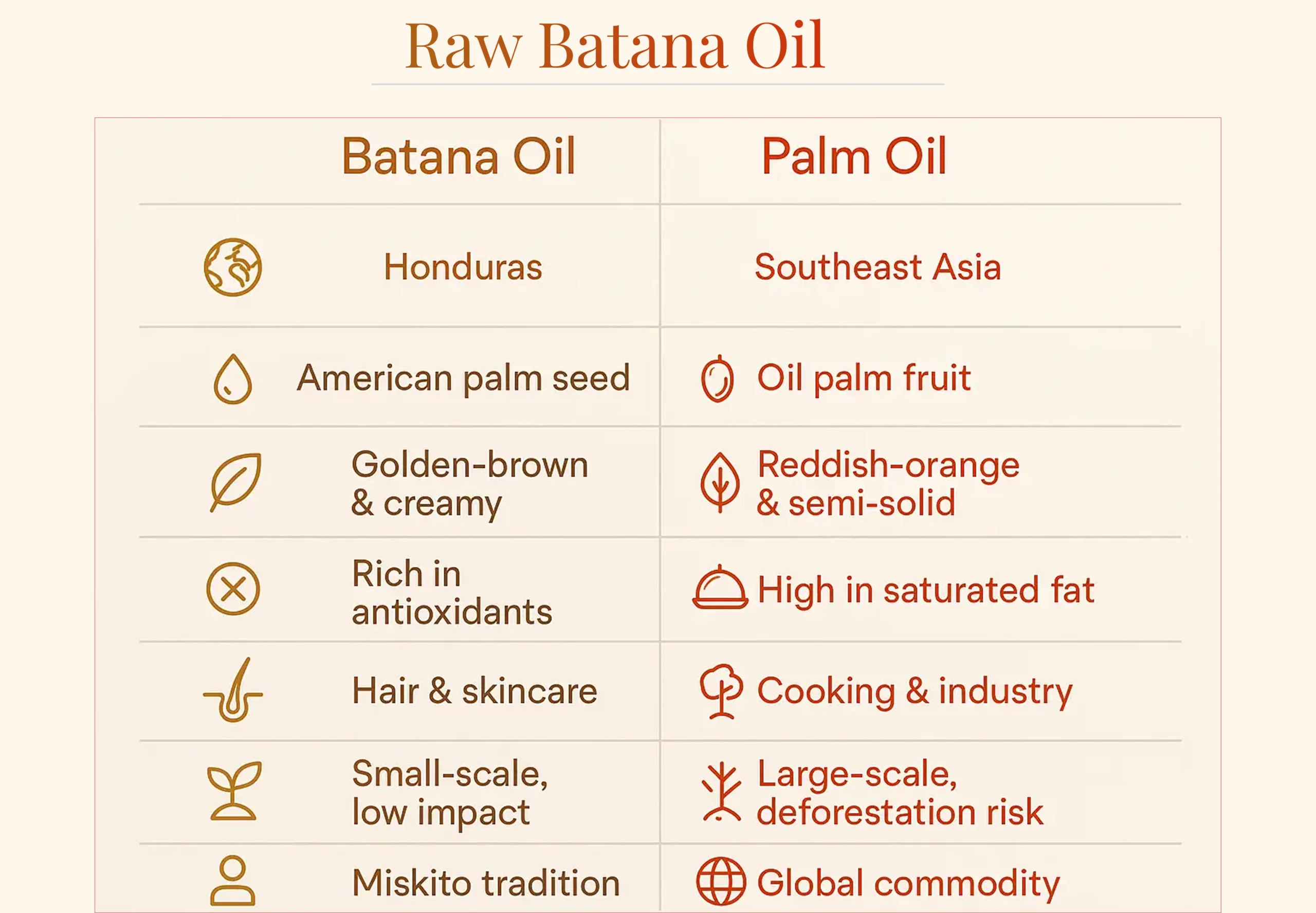
Sometimes it helps to just see the key differences laid out clearly:
| Batana Oil | Palm Oil | |
|---|---|---|
| Source Plant | Elaeis oleifera (American oil palm) | Elaeis guineensis (African oil palm) |
| Origin | Honduras, Central/South America | West Africa; cultivated in SE Asia |
| Production | Traditional, wild-harvested, cold-pressed | Industrial, plantation-grown, refined |
| Color (unrefined) | Deep reddish-brown | Orange-red (red palm) or pale yellow (refined) |
| Oleic Acid Content | Higher | Lower (more palmitic/saturated) |
| Primary Use | Hair and scalp treatment | Food industry, cosmetics, processed goods |
| Environmental Impact | Low (wild-harvested, community-based) | High concern (deforestation, monoculture) |
| Cultural History | Miskito indigenous tradition, Honduras | Wide industrial and culinary use |
Frequently Asked Questions
Q: Is batana oil just another name for palm oil?
No — they’re related but distinct. Batana oil comes from Elaeis oleifera, the American oil palm native to Central America, while conventional palm oil comes from Elaeis guineensis, the African oil palm. Beyond the botanical difference, their fatty acid profiles, production methods, cultural histories, and practical uses are meaningfully different. Calling batana oil “palm oil” would be a significant oversimplification.
Q: Can I substitute palm oil for batana oil in a haircare routine?
Not effectively, no. While both contain fatty acids beneficial to hair, cold-pressed batana oil has a specific nutritional composition — particularly its beta-carotene, tocopherols, and high oleic acid content — that refined palm oil simply doesn’t match. The therapeutic reputation of batana oil is tied to its specific compounds and how they’re preserved through traditional cold-press extraction.
Q: Is batana oil more sustainable than palm oil?
When sourced from reputable producers who work directly with Miskito communities in Honduras, yes — significantly. Wild-harvested batana oil production doesn’t require deforestation or plantation farming. That said, as with any natural ingredient, sourcing transparency matters. Always look for brands that can clearly explain where and how their oil was produced.
Q: Does batana oil smell like palm oil?
No. Cold-pressed batana oil has a distinctive earthy, smoky, nutty aroma that’s quite different from palm oil’s scent. That smell is a characteristic of the American oil palm species and the traditional cold-press extraction process — and it’s one of the sensory markers of a genuine, unrefined product.